
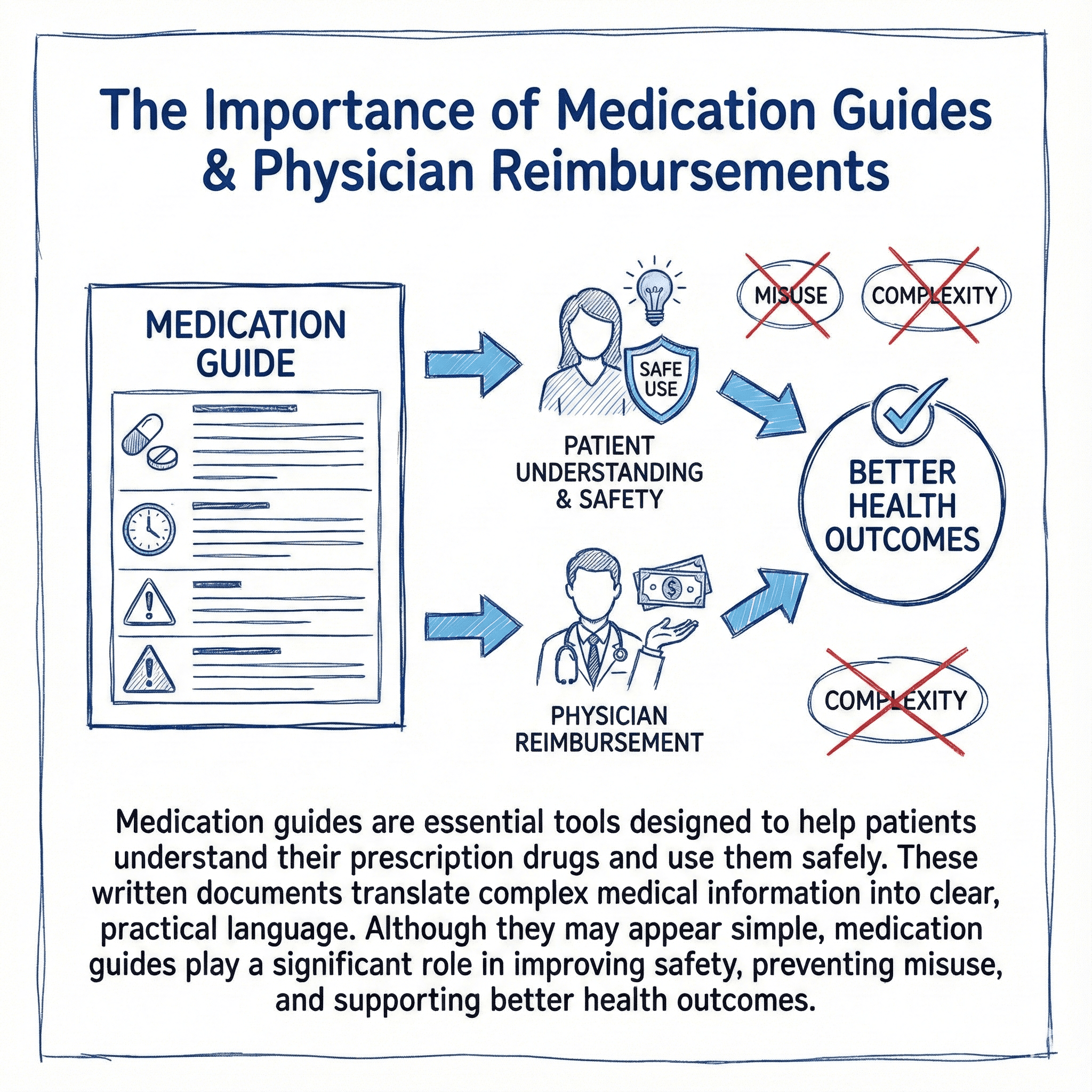
The Importance of Medication Guides & Physician Reimbursements
Helping Patients Use Medicines Safely and Effectively
Medication guides are essential tools designed to help patients understand their prescription drugs and use them safely. These written documents translate complex medical information into clear, practical language. Although they may appear simple, medication guides play a significant role in improving safety, preventing misuse, and supporting better health outcomes.
Making Complex Information Understandable
Prescription medications can be complicated. They differ not only in how they work, but also in how they should be taken, what side effects they might cause, and what substances they shouldn’t be combined with. A medication guide takes all this information and presents it in a way that patients can easily understand.
This is especially important for people who may not have medical training or who need straightforward explanations to feel confident about their treatment. By providing clear directions such as when to take a dose, whether to take it with food, or what to avoid, medication guides help reduce confusion. When patients know exactly what to expect, they are less likely to make mistakes like skipping doses, taking too much, or combining medications unsafely.
Supporting Patient Empowerment and Engagement
One of the most valuable aspects of medication guides is their ability to empower patients. Understanding why a medication is prescribed, what benefits it should provide, and what risks it carries encourages people to take an active role in their healthcare. Instead of feeling like passive recipients of treatment, patients become informed partners.
This engagement can have a big impact. When patients feel confident and informed, they are more likely to take their medications as directed and communicate openly with their healthcare providers. This can lead to better treatment outcomes, fewer complications, and a stronger patient-provider relationship.
Preventing Misuse and Identifying Risks Early
Many medications come with specific risks; some mild, others potentially serious. Medication guides highlight these issues clearly, helping patients recognize which symptoms are common and which could be warning signs.
This early awareness can be lifesaving. For example, if a drug can cause allergic reactions, mood changes, or interactions with alcohol or other prescription drugs, the guide will outline exactly what to watch for and when to seek medical help. Medication guides also discourage misuse, whether accidental or intentional. By explaining proper storage, dosing instructions, and potential interactions, they help prevent harmful mistakes. This is especially critical for medications that affect the nervous system, immune system, or heart, where incorrect use can have serious consequences.
Building Trust and Improving Overall Safety
Medication guides contribute to a broader culture of safety in healthcare. Patients often receive a lot of information during appointments, and it can be difficult to remember everything. A medication guide provides a dependable reference that patients and caregivers can revisit anytime. This reduces uncertainty and builds trust, allowing people to feel more comfortable with their treatment plan.
In addition, medication guides help standardize essential safety information. Everyone who receives the medication gets the same clear, evidence-based instructions, reducing the chance of misunderstandings or inconsistent advice.
Common Questions for Physicians:
For physicians placing infectious disease testing orders for patients, can they get reimbursed for their time to:
- Explain lab test results and treatment plans to patients
- Provide patients a printed Patient Instruction about the antibiotics recommended/prescribed with the potential side effects, Drug-Drug Interaction and Drug-Food Interaction
If so, what is the proper CPT codes to use for reimbursement?
Short answer: Yes, you can get reimbursed.
The time a physician spends explaining infectious disease test results, discussing the antibiotic plan (including DDI/DFI risks), and giving patient-specific instructions is billable as part of an E/M visit.
- Select 99202–99215 by MDM or total time; the 2021+ E/M rules explicitly include counseling/education and independently interpreting results and communicating them to the patient in the countable time.
- Printed handouts are ordinarily bundled into the E/M service and not paid separately.
Which codes to use (by scenario)
| Scenario | What to submit | Key rules to know |
|---|---|---|
| In-person visit (or audio-video telehealth) to review results & treatment | 99202–99215 (choose by MDM or total time) | Time may include counseling/education, interpreting labs and communicating results, documenting the note, etc. |
| Visit runs long (same day as the E/M) | +99417 (commercial payers that follow CPT) or G2212 (Medicare) | Add when total time exceeds the highest level (99205 or 99215) by ≥15 minutes. CMS requires G2212 for office/outpatient prolonged time; CPT uses +99417. |
| Audio-only conversation to explain results | Commercial payers (CPT 2025): 98008–98015 (audio-only E/M) with modifier 93 if required. <br>Medicare FFS: use 99202–99215 with modifier 93. | CPT created audio-only E/M codes for 2025; CMS did not adopt them for Medicare. |
| Very brief patient-initiated check-in | 98016 (brief communication technology-based service) | Replaces G2012 in CPT. Cannot be used if related to an E/M in the prior 7 days or that leads to an E/M within 24 hours/soonest available. |
| Portal/e-visit message thread (up to 7 days) | 99421–99423 (5–10, 11–20, 21+ minutes cumulative) | Report once per 7-day period for established patients; exclude time that triggers an E/M within 24h or relates to an E/M in prior 7 days. |
| Education delivered by a non-physician QHP | 98960–98962 (patient self-management education; non-physician only) | For qualified non-physician professionals using a standardized curriculum; not physician E/M. Coverage varies. |
Easy Guide to Billing Long Result-Review Visits and Antibiotic Counseling
When you review test results with a patient and talk about antibiotics, the billing depends on how long the visit takes and whether it was in person, video, phone, or portal message.
When Time Counts as “Prolonged”
Commercial Insurance You can add a “prolonged time” code (+99417) when:
- New patient (99205): Visit lasts 75–89+ minutes
- Established patient (99215): Visit lasts 55–69+ minutes
- More time = more units of +99417.
Medicare Uses a different prolonged code (G2212):
- New patient (99205): Starts at 89–103 minutes
- Established patient (99215): Starts at 69–83 minutes
- Again, more time = more G2212 units.
What Doesn’t Get Paid Separately
- Printed instruction sheets (like antibiotic side effects or interaction lists) are included in the visit. Insurance almost never pays extra for them.
- General education that isn’t specific to that patient doesn’t count toward visit time. Patient-specific = counts. Generic = doesn’t.
How to Choose the Right Code
- Was there a real visit (in person or video)?
- Use 99202–99215.
- Add prolonged time code if the visit truly went long.
- Was it phone only?
- Commercial insurance: 98008–98015 + modifier 93.
- Medicare: 99202–99215 + modifier 93.
- Quick 5–10 min check-in: 98016.
- Was the conversation through the portal over several days?
- 99421–99423.
- Printed instructions?
- Included in the visit. No separate payment.
Bottom Line
- Bill the result review and antibiotic counseling as 99202–99215.
- Add +99417 (commercial) or G2212 (Medicare) only if the visit was really long.
- Audio-only visits have special rules.
- Printed instructions aren’t paid separately—just document that you gave them.
How Much More Does Medicare Pay for a Long Visit?
Using 2025 national Medicare rates:
Established Patient
- Long visit (99215 + G2212): $206.69
- Short visit (99212): $54.99
- Difference: +$151.70 (about 4× more)
New Patient
- Long visit (99205 + G2212): $246.80
- Short visit (99202): $69.87
- Difference: +$176.93 (about 3.5× more)
Every extra 15 minutes of prolonged time adds another $31.